

Over the past several generations, stress levels and chronic disease levels have continued to rise.
According to the American Psychology Association, on average, younger adults are more likely than older generations to report that their stress has increased in the past year. 47% of all Americans say they are concerned with the amounts of stress in their lives. People experiencing stress are more likely to report hypertension, anxiety, depression or obesity.
Overall, adults report that stress negatively impacts their mental and physical health. And by 2025, chronic disease is predicted to affect an estimated 164 million Americans – nearly half of the population.
Case studies have shown that Tai Chi may be an effective method of stress reduction, among other health benefits.
Evidence from studies conducted by the UCLA Center for East-West Medicine suggests that Tai Chi may reduce depressive symptoms, stress, and anxiety.
So, What is Tai Chi?
The mind-body practice of Tai Chi stems from Ancient Chinese tradition, combining martial arts exercises and meditative practice to achieve harmony of mind, body, and spirit.
Tai Chi may be considered “meditation in motion”. By focusing the mind introspectively, this practice is believed to improve the flow of Qi (Chi). Qi is the energy force coursing through our bodies. The slow, focused movements, combined with deep breathing, promote balance.
Tai Chi takes different forms:
Short forms are usually 13 to 40 moves long and take about 3 to 20 minutes to complete. The more advanced long forms may consist of more than 80 movements and take over an hour to complete.
When executed quickly, Tai Chi movements may be considered a form of self-defense.
Motion in Tai Chi is constant, with each posture flowing into the next. Many of the moves are named for animal actions, such as “White crane spreads wings”, “Grasp bird’s tail”, and “Part horse’s mane”.
During these movements, you should have focused attention, deep and natural breathing, and relaxed muscles.
Who can do Tai Chi?
Tai Chi is safe for all ages and levels of skill. The practice is low impact, and since no special equipment is required, it can be performed anywhere, alone or in an organized group class.
While Tai Chi is especially famous as a practice for older people who don’t otherwise exercise, we can all benefit!
Why experiment with Tai Chi?
Although originally developed as a form of self-defense, Tai Chi has evolved into a common exercise for stress reduction and other health benefits.
According to the Mayo Clinic, more than 2.5 million Americans practice Tai Chi to reduce stress and anxiety. Not only that, it helps increase energy, stamina, flexibility, muscle strength and definition, and balance.
Key benefits may include:
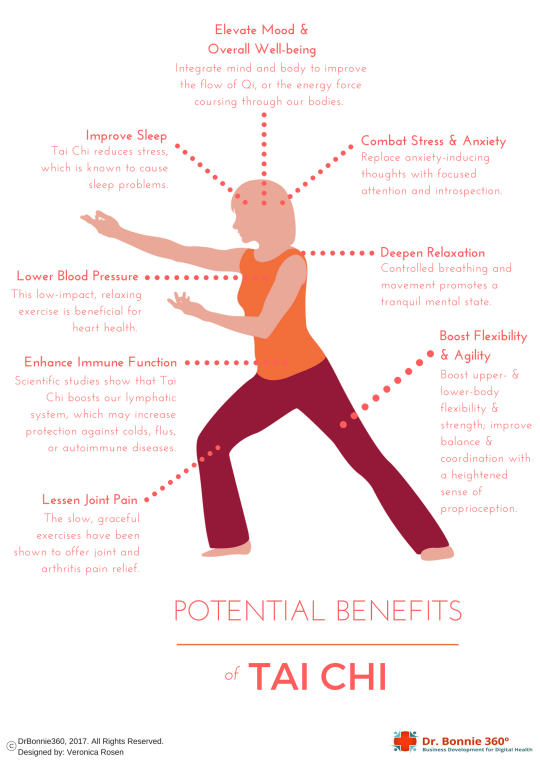
Research from Harvard Medical School supports that Tai Chi exercises may lead to greater muscle strength and flexibility. Additional research provides evidence connecting Tai Chi with increased balance control and lessened chronic pain, particularly for cases of osteoarthritis, fibromyalgia, and lower back pain.
Further, mind-body practices tend to be less costly and cause fewer side effects than prescription drugs, and may even reduce necessary doses of pain management drugs.
What about Qi Gong?
Qi Gong is another Ancient Chinese exercise that consists of meditation, controlled breathing, and movement. Roughly translating to “mastering your energy”, Qi Gong aims to cultivate physical, spiritual, and emotional health.
One of the most common forms used as exercise is Baduanjin Qi Gong.

This form consists of a series of 8 movements, beginning with (1) “Two hands support the heavens” and culminating with (8) “Bouncing on the toes”. The focus of this sequence is on harnessing energy and health.
Tai Chi is sometimes referred to as a form of Qi Gong, built upon its fundamental principles. On the surface, Tai Chi and Qi Gong are similar in many ways (for one thing, Qi and Chi are the same word in two different transliteration systems)…
Both movement therapies have various similarities. They seek to reduce stress, increase energy, incorporate strength, flexibility, breathing, and focus. Not only that, they emphasize relaxation and slowness to calm the body. The use of movement, breathing, and meditation is to guide circulation of Qi through the body.
However, in trying to choose the correct movement therapies for yourself, it is important to differentiate the two practices:
Qi Gong consists of simple, slow, repeated movements, often more straightforward than those of Tai Chi. Qi Gong forms may consist of one movement repeated consistently.
In contrast, the more complex forms of Tai Chi consist of a series of many moves and can take months to learn. Movements of Tai Chi place greater emphasis on martial arts and self-defense.
When grouped together as meditative movement, research trials have shown Tai Chi and Qi Gong to collectively be effective for bone health, cardiopulmonary fitness, falls prevention, immunity, anxiety, depression, and overall quality of life.


9 Comments
How to Fight Fatigue – DrBonnie360 presents · April 17, 2019 at 5:44 pm
[…] you hit that afternoon lull, try an active movement designed to increase your energy levels such as Tai Chi & Qi Gong. If you feel stressed, try breathing exercises or meditation to relax your system. Remember, stress […]
Why Collaboration is So Important in Autoimmune Disease · May 8, 2019 at 2:06 pm
[…] Obesity itself is an inflammatory state. However, whether you are obese or not, exercise has been found to alter IL-6 cytokines from their proinflammatory trans-bonded state to their anti-inflammatory cis-bonded state. While some people may choose to hit the gym or go for a five-mile run, those that want to start out at a lower intensity can find more exercise options here. […]
How to Reduce Stomach Pain and Bloating – DrBonnie360 presents · May 14, 2019 at 5:49 pm
[…] an active movement designed to reduce stress and promote relaxation such as Tai Chi & Qi Gong. If you prefer a less active movement, try breathing exercises or meditation to relax your system. […]
How to Relieve Achy Muscles and Joints – DrBonnie360 presents · May 20, 2019 at 7:36 pm
[…] can stiffen up. Try an active movement designed to relax your muscles and reduce joint pain such as Tai Chi & Qi Gong. If you feel stressed, try breathing exercises or meditation to relax your system. Remember, stress […]
How to Reduce Anxiety – DrBonnie360 presents · May 22, 2019 at 6:26 pm
[…] Tai Chi & Qi Gong are good exercises for combating stress and anxiety—they focus on redirecting thoughts and promoting relaxation. If you feel extra stressed, try breathing exercises or meditation to relax your system. There are so many different ways to move your body, and any type of exercise can be beneficial for anxiety, but it is important to find the right therapy cocktail for your body. Our guide to movement therapy can help you on this journey. […]
How to Reduce Stomach Pain and Bloating - DrBonnie360 presents · June 12, 2019 at 8:21 pm
[…] an active movement designed to reduce stress and promote relaxation such as Tai Chi & Qi Gong. If you prefer a less active movement, try breathing exercises or meditation to relax your system. […]
How to Naturally Improve Your Mood – DrBonnie360 presents · June 24, 2019 at 6:49 pm
[…] Tai Chi & Qi Gong are movements that are supposed to elevate mood and wellbeing, as well as combat stress and anxiety. If you feel stressed, try breathing exercises or meditation to relax your system. Yoga is often used to reduce depression and anxiety, as it can tame the body’s stress response. The Feldenkrais method integrates mind & body using movement and is shown to elevate mood. There are so many different ways to move your body, but it is important to find the right therapy cocktail for your body. Our guide to movement therapy can help you on this journey. […]
How to Reduce Anxiety – Your Autoimmunity Connection · November 5, 2019 at 12:01 am
[…] Tai Chi & Qi Gong are good exercises for combating stress and anxiety—they focus on redirecting thoughts and promoting relaxation. If you feel extra stressed, try breathing exercises or meditation to relax your system. There are so many different ways to move your body, and any type of exercise can be beneficial for anxiety, but it is important to find the right therapy cocktail for your body. Our guide to movement therapy can help you on this journey. […]
Chinese TuiNa | Know The What, How, Benefits And Uses - Love4Wellness · February 23, 2021 at 7:13 pm
[…] Tui-Na (Chinese 推拿, Pinyin tuīná – “pressing and grasping”) is an independent Chinese massage form. It is one of the five main pillars of traditional Chinese medicine (TCM) that includes Chinese herbal therapy, acupuncture, Chinese dietetics, the massage therapy Tui Na, and the movement therapies Qigong and Tai Chí-Quan. […]