

The dimensions of Big Data can be summed up by The Four Vs: Volume, Variety, Velocity, and Veracity.
But however large or diverse one’s data, it can often be hard to find exactly what one needs.
As a researcher, I spend a lot of time on Google. I might open a multitude of tabs just to find a few good answers. I wish I had a multilayered document where I could click and drill down to find new information efficiently as new questions arise during the research process.
William King, founder and CEO of Zephyr Health, experienced a similar problem while working at Johnson & Johnson, so he set out to build “a product that would bring together information quickly and in a way that customers can visualize.”
Zephyr Health is a business solution targeted to decision makers in healthcare, allowing business users to connect multiple sources of data from both private and public datasets and turn them into organized, actionable information. Each of the applications in Zephyr’s suite provides several layers of information and different ways to extract and analyze data. With the click of a button you can view multiple levels of detail – the perfect research tool!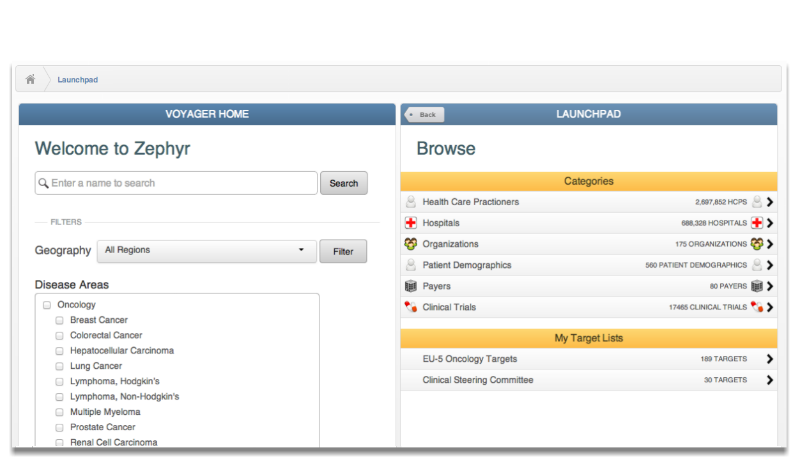
As shown below, if you want more detailed information about a practitioner, a hospital, or a clinical trial, it is all available on the same screen in an intuitive, easy-to-use interface.
Once you select the category of information, you can easily view details on a practitioner, such as how many clinical trials he has done, how much NIH funding he has received, or how many publications he’s produced. This allows pharmaceutical companies to easily identify the best candidates for clinical trials.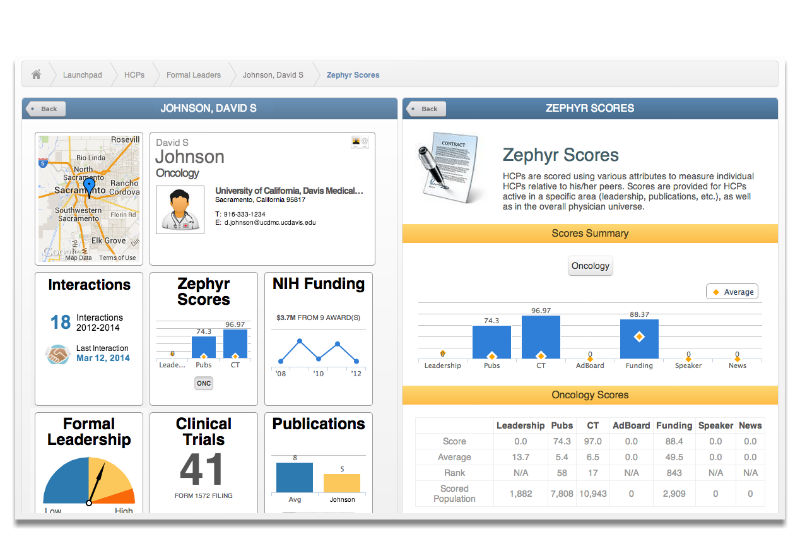
“As a big data analytics company, the great thing about our applications is that they draw disparate data sources together and then use algorithms to solve a specific business problem,” continued William King.
Zephyr Health’s data analytics platform optimizes efficiency and accuracy in the clinical trial site selection process as well as in patient recruitment and post-approval marketing. The goal is to deliver beneficial drugs to the patients that need them faster than was possible before, ultimately improving or even saving lives.
Overall, I am excited because Zephyr Health’s easy-to-use approach provides an elegant way to take large, disparate data sets and turn them into useful information. I can envision many of the healthcare stakeholders finding this approach useful – medical device manufacturers, hospitals, researchers who work with large datasets, and more.
As a healthcare consumer who also happens to be a visual learner, I would love to see this easy-to-understand approach applied to my medical records and lab results. What do you think?


0 Comments